
When it comes to placing a rug, it’s not just spreading it out. But it’s all about the placement.
Knowing how to position an area rug in a bedroom is tough, and you certainly need a tape measure when deciding the right size.
Too far under the bed and your rug disappears. Too little and it looks unplanned.
Interior designers have rug under the bed rules, to make your bedroom look a lot more sorted and homey, and not an experiment.
Why Does the Rug Under the Bed Matter?
A rug anchors the whole room.
Without a rug in your bedroom feels scattered, like the furniture is just floating around with no clear focus.
The right rug pulls the bed, nightstands, and surrounding pieces into one cohesive space. It gives the room a visual center, or a box.
Beyond looks, there’s practicality. A rug adds warmth underfoot, softens noise, and makes those early morning steps out of your bed a lot more comfortable.
Interior designer Sarah Barnard says, “A well-placed rug defines the sleeping zone and gives the room a sense of intention.”
Get the placement wrong, and even a beautiful rug can make a room feel awkward, full, and unfinished.
Rug Under the Bed Rules: Non-Negotiable
Before you move anything around, there are some unsaid rug under the bed rules.
And following these means a perfectly sorted bedroom, and the perfect rug placement.
1. Always Leave Equal Exposure on Both Sides
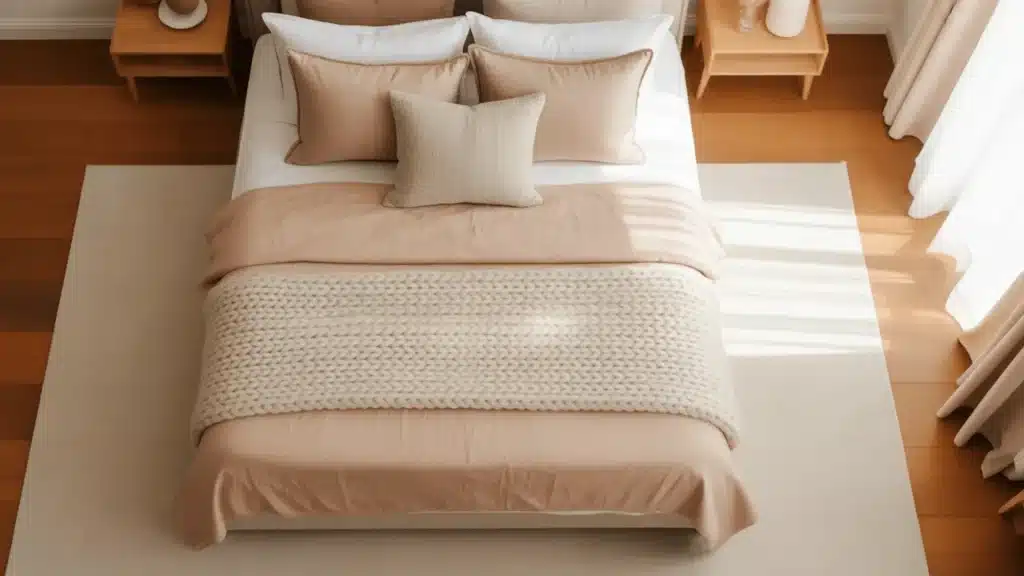
The rug should extend the same distance on both sides of the bed.
Uneven exposure looks weird and is one of the most common mistakes people make. But the easiest way to fix it is with a tape measure before you commit.
2. At Least 18 Inches Should Show Beyond the Bed Frame
This is the standard rule most interior designers follow.
18 to 24 inches of rug visible on the sides and foot of the bed gives the space a balanced, intentional look. A non-negotiable rule.
3. Never Let the Rug End at the Nightstands
The rug should sit underneath the front legs of your nightstands.
Cutting off at the nightstand makes the layout feel choppy and disconnected.
4. The Foot of the Bed Needs Coverage Too
People focus only on the sides and forget the foot.
The rug should extend at least 12 to 18 inches past the foot of the bed frame. This ties the whole sleeping area together.
5. Size Up When in Doubt
A rug that is too small is a far more common problem than one that is too large.
If you are on the fence between two sizes, always go bigger. A larger rug almost always looks more intentional and polished.
Let me tell you that eyeballing never works. Before buying, I tape out the rug dimensions on the floor with painter’s tape. It takes five minutes. Try it once, and you will never skip it again.
How to Position an Area Rug in a Bedroom: According to Bed Size
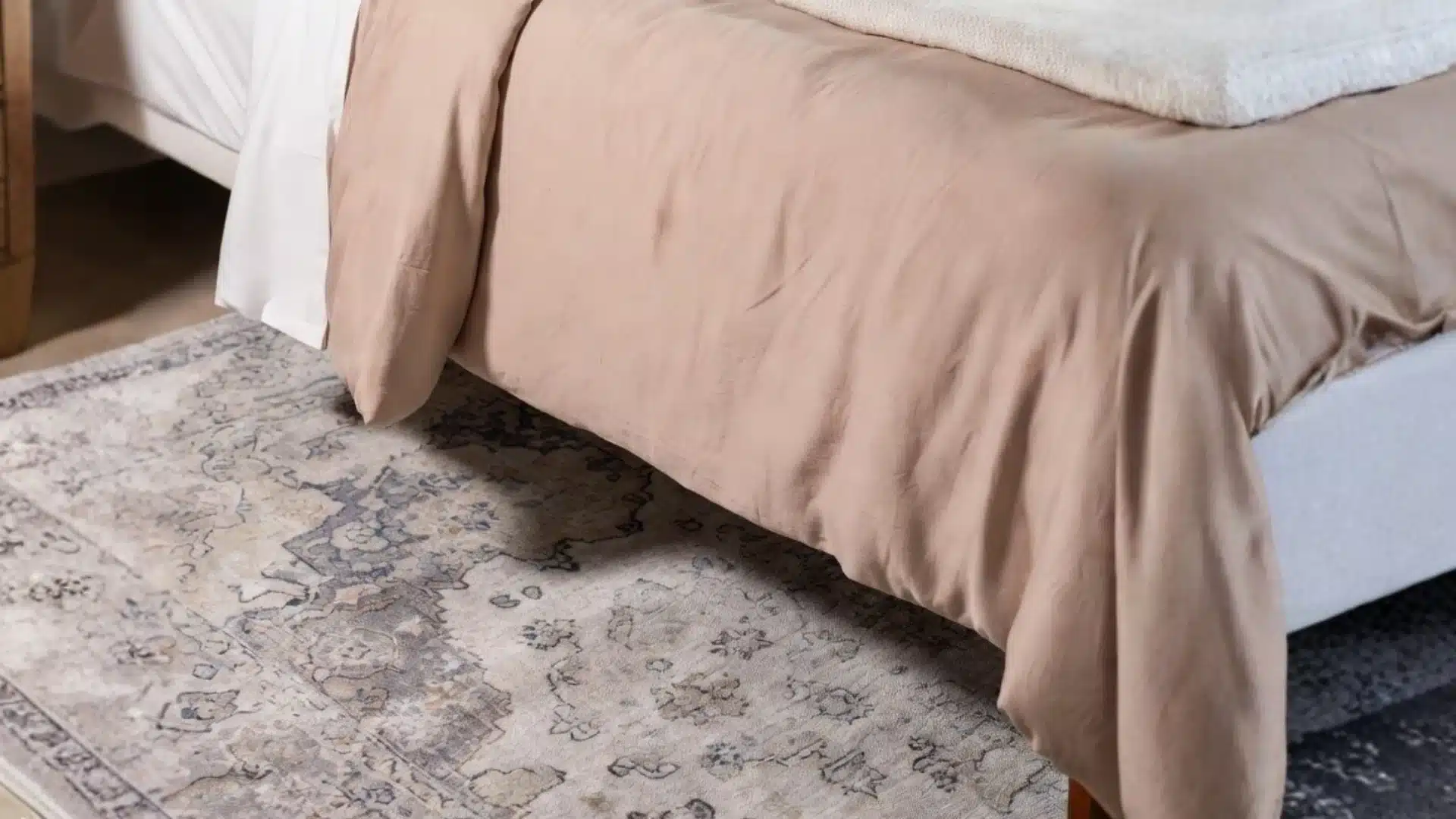
Bed size changes everything when it comes to rug placement. A size that works perfectly under a queen can look completely lost under a king.
Before picking a rug, you need to know the size of your bed.
These are the standard rug size guidelines for the most common bed sizes.
1. Twin and Twin XL Beds
A twin bed gives you the least floor space to work with.
A 5×8 rug is the most practical choice and works well in most twin setups. Place it so it extends about 18 inches on the sides and runs past the foot of the bed.
In smaller rooms, a 4×6 can work as long as it still clears the foot of the frame.
Keep the placement centered and avoid pushing the rug too far under the bed.
2. Full or Double Beds
A full bed sits in an interesting middle ground. It is bigger than a twin but does not need the same scale as a queen.
A 6×9 rug is often the go-to for most full bed setups. It gives you enough coverage on the sides while still showing well at the foot.
If your room has more space, an 8×10 works too and gives the room a more grounded feel.
Just make sure the rug stays centered with the bed frame.
3. Queen Beds
Queen beds are the most common setup. An 8×10 rug is the best choice and fits most queen bedroom layouts without much adjustment.
It should extend around 18 to 24 inches on both sides and at least 12 to 18 inches past the foot of the bed.
If your room runs larger, a 9×12 gives extra breathing room and still looks proportional. Either way, center the rug with the bed and let it do the anchoring work.
4. King and California King Beds
A king bed needs a rug that can hold its own. Anything smaller than a 9×12 looks undersized against the width of a king frame.
A 9x12is the minimum recommendation, and in larger rooms, a 10×14 is an even better fit.
California king beds run longer than standard kings, so pay close attention to the length of the rug and make sure it clears the foot of the frame with enough visible coverage.
Latest Rug Placement Ideas
Not every bedroom follows the same layout, and rug placement has become much more creative and exciting in recent years.
-
Layered Rugs: Place a larger natural-fiber rug as a base, then layer a smaller patterned rug on top for added texture and charm.
-
Angled Placement: Rotate the rug at a slight diagonal under the bed to add visual movement and break up a boxy room layout.
-
Runner on Each Side: Skip the single large rug and use two matching runners along each side of the bed for a clean, symmetrical look.
-
Rug at the Foot of the Bed Only: Place a smaller rug or runner just at the foot of the bed for a minimal, intentional style that works well in compact rooms.
-
Oversized Rug Wall to Wall: Use a large rug that nearly fills the entire floor for an enveloping feel, a trend in maximalist bedroom interiors.
-
Contrasting Shape: Use a round rug in a room full of rectangular furniture to create an unexpected focal point that draws the eye toward the bed.
-
Double Rug Symmetry: Place two identical rugs side by side under a king or California king bed, aligned perfectly, for a bold and structured look.
Conclusion
Turns out, rugs have opinions. And now you know how to listen to them.
Getting the placement right is not about following a strict design rulebook. But understanding how things work for you and your room.
And please stop guessing and start measuring. Painter’s tape is your best friend before any rug purchase, and going a size bigger almost never hurts.
A well-placed rug can completely change how a bedroom feels without changing a single piece of furniture.
Frequently Asked Questions (FAQs)
1. Are People Still Carpeting Their Bedrooms?
Yes, bedroom carpeting is still popular. Many homeowners prefer the comfort it adds underfoot.
2. Should Rugs Be Lighter or Darker than Walls?
Lighter rugs open up a space, while darker rugs add warmth and depth. It is important to keep enough contrast between the two.
3. What Color Carpet is in Style in 2026?
Warm neutrals like terracotta, sandy beige, and soft clay tones are trending now.
4. What Color Rug Makes a Room Look Larger?
Light colors like cream, soft white, and pale beige make a room feel more open and spacious.